
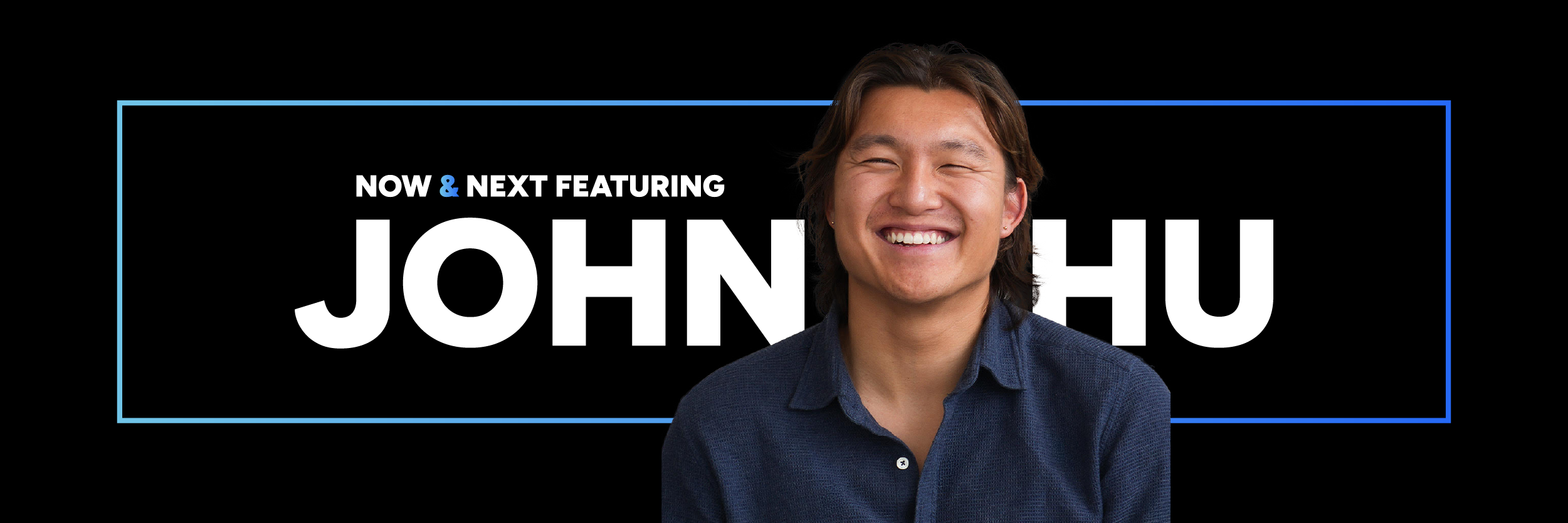
This feature is part of the Voices of the Now & Next series—a collaboration between VaynerSpeakers and the New York Stock Exchange, highlighting influential leaders shaping markets, culture, and business today.

Co-Founder & CEO, Stan
John Hu’s understanding of money was shaped long before boardrooms or balance sheets. It came from early exposure to how income is created, managed, and sustained when nothing is assumed.
Raised by a single, immigrant mother who worked two jobs in parallel — mechanical engineer by day, eBay entrepreneur by night — Hu grew up watching money be discussed and handled in real time. It wasn’t theoretical or guaranteed; it required intention. Discipline wasn’t motivational, but practical.
After graduating, Hu cold-called his way into Goldman Sachs, breaking through a sub-1% acceptance rate to see how institutional capital actually moves. The patterns were clear: money flowed toward established categories, traditional business models, and clean balance sheets.
Although at the same time, culture was shifting with the rise of social media. Independent creators were beginning to generate real revenue outside traditional institutions, but without the infrastructure or legitimacy afforded to more established business models.
So… there was an opportunity.

The creator economy is now a $200B+ market, fueled by a massive wave of people leaving traditional careers to build independent businesses online. By the time John Hu stepped into the space and began posting his own content, the momentum was already undeniable.
What hadn't caught up was the infrastructure.
Creators were generating revenue inside systems that treated monetization as an afterthought. Turning knowledge, taste, or trust into income meant stitching together link-in-bio tools, payment processors, and analytics dashboards that were never designed to work together. There was no true operating layer—just a series of workarounds that made growth harder instead of easier.
Creators didn’t struggle because they lacked talent or business instincts. They struggled because the tools available weren’t designed for people building companies through their work, not around it.
That gap led John to co-found Stan—an all-in-one platform that lets creators monetize their audience in one place.
The idea was simple: make it easier for people to get paid for the work they were already doing. Stan wasn't built to teach creators how to monetize; it was built to remove the friction altogether.

The creator economy has already proven the model. Creators generate demand, command attention, and build revenue. The assets they've created—knowledge, community, trust—are tangible and valuable. They're just measured by different standards than traditional business.
The next decade is about the individual empire: businesses founded on personal influence, scaled on individual terms, and built as standalone enterprises.
What makes this shift inevitable is infrastructure. The tools that turn influence into durable business.
Nike didn't teach people to run. It built the infrastructure that turned running into an industry.
John is doing the same for creators through Stan and the Dare to Dream Challenge. He's building the operating system for individual empires—the financial rails, operational frameworks, and institutional recognition that let people turn influence into lasting enterprise. As that infrastructure matures, it doesn't just support creators. It redefines wealth creation: who gets to build, how value compounds, and what scale looks like when you own the entire stack.
The individual empire isn't coming. It's here. The infrastructure is what makes it permanent.

 It’s a wild time—and a big moment for you. I want to talk about Stan. You were very intentional about who this platform is for. You’ve said it’s built for entrepreneurs—not influencers. Why was that important?
"I’d actually argue that influencers are entrepreneurs—most of them just don’t recognize it yet. At Stan, our mission is to empower anyone to make a living working for themselves. That’s the dream. Nobody wants to be stuck in a nine-to-five that doesn’t fulfill them. What’s exciting about today—with AI and modern tools—is that anyone can start building something of their own in just a few hours. Our job is to give people the tools to actually pursue that dream.
Whether it’s a creator, a local mom-and-pop business, an accountant, a lawyer, or a startup founder building a brand—we help all of them. Helping people build their dreams is what makes this fun."
You talk a lot about dreams. “Dare to Dream” feels like a real ethos for you. What does that mean in practice?
"'Dare to Dream' is our version of Just Do It. That’s how we think about what Stan is meant to be."
Right now, we’re running a campaign called Dare to Dream: New Year, New Me. Anyone who’s been sitting on an idea—saying, “I want to start this” or “I want to try that”—can submit a video. We’re selecting one person and giving them $100,000 to go pursue their dream."
Correct me if I’m wrong—Stan doesn’t take backend participation from founders. That’s a non-negotiable for you?
"That’s right. At the end of the day, we want to make entrepreneurship as successful as possible. I think back to growing up as an immigrant kid—going to Costco, getting every deal possible, splitting a slice of pizza and a hot dog.
That shaped my mindset: How do we build a long-term, sustainable business that allows as many entrepreneurs as possible to succeed? That’s why the 0% fee structure matters so much to us."
What does being “a Stan” mean to you?
"It means being that friend you can always call. That’s what I hope Stan is for entrepreneurs and creators—the thoughtful friend who gives candid advice, but in a kind and supportive way. Someone you can rely on in great moments and in hard ones."
You’ve described Stan as “the Nike for entrepreneurs.” What does that mean in practice?
"That’s the dream. The same way we all feel inspired watching a Michael Jordan or Serena Williams Nike ad—I want every kid, no matter their background, to see someone who looks like them, who’s gone through similar struggles, succeeding in entrepreneurship. That wasn’t something I had growing up.
Today, Stan supports over 80,000 entrepreneurs from every walk of life—the high-school hustler, the single mom in the Midwest, the first-time founder. I want us to tell their stories and inspire people the way Nike inspires athletes."
What do you think is a common misconception about building a business online—especially around autonomy and authority?
"Building an online business is the same as building any business—just through a different channel. Modern founders need to understand the internet first: social content, digital distribution, and how people communicate online. It’s the same fundamentals—just powered by new technology and media platforms."
Twenty years from now, what do you hope people say about Stan?
"I hope they say we fundamentally lifted the success curve of entrepreneurship.
This journey is already hard—mentally, emotionally, across every dimension. If we can provide better tools, education, and support to make that journey more survivable and more successful, I’d be incredibly proud of that legacy."
You clearly have a deep passion for what you’re building. Is that essential for entrepreneurs?
"Every day, something new wrecks you—in a way that forces you to grow. You think you’re ready, and then something hits you that expands your capacity again. I don’t think you reach the highest levels without deep, intrinsic motivation. Without it, you won’t make it.
You’re constantly tearing muscles to rebuild them. That’s the game. It takes years. But moments like this remind you that you’re going in the right direction."