
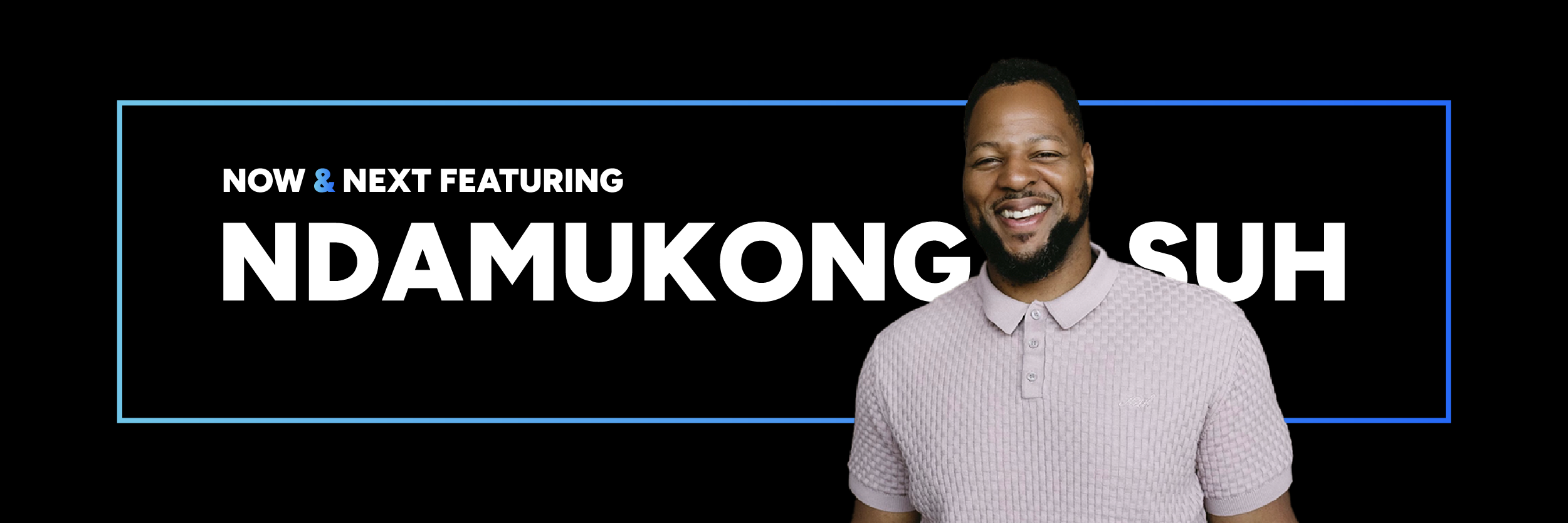
This feature is part of the Voices of the Now & Next series—a collaboration between VaynerSpeakers and the New York Stock Exchange, highlighting influential leaders shaping markets, culture, and business today.

Suh's work today sits at one of the most influential junctions in modern business: where cultural relevance meets financial capital.
His investment approach is consistent and disciplined: invest in structural shifts, not surface trends. Housing innovation over hype. Community-rooted real estate over quick returns. Athlete-backed ownership models over endorsement deals. His filter is simple: go where markets are moving, not where they are crowded.
One of the most defining relationships of his career began in 2009 on a Nebraska sideline. Warren Buffett was the honorary captain. A friend dared Suh to ask him for mentorship. He did—and Buffett said yes. The mentorship continues today.
Their quarterly conversations gave Suh the operating principles that define him:
Buffett reinforced something Suh already knew: the qualities that create elite athletes—discipline, preparation, pattern recognition, conviction under pressure—map directly onto elite investing.

Suh dismantled the old narrative early. At 29, while still in the NFL, he became the youngest board member of a public company in Omaha. With Intuit, he didn’t just appear in campaigns; he helped architect financial literacy programs designed to close what he sees as the biggest gap for athletes entering business: understanding the mechanics of money before the spotlight fades.
The mindset has shifted. Short-term paydays aren’t the goal; long-term ownership is. Today’s athletes want equity, not exposure. They’re focused on building generational wealth through real estate, public markets, and community-rooted investments—not just lending their face to a company.
Suh has watched too many athletes become exceptions rather than examples, celebrated for what they accomplished alone, instead of what they made possible for others.
He's creating a playbook for an entire generation of builders who've been overlooked by traditional capital.

 You retired from the NFL just a few years ago, but you’ve done a TON since you left the NFL. Tell us what you’ve been up to.
"Retired officially. Embraced the media space, started a podcast, “No Free Lunch,” working on development projects."
Education didn’t take a backseat to your athletic career. How has that translated to your business life?
"Growing up with a mother who was a school teacher, education was not an option; it was a demand. And my father was an engineer, so between the two of them, and being both from third-world countries, it was without a question something that had to be accomplished. We loved sports, but school was first and foremost. It was ingrained in me."
You were known for your aggressive playing style. Do you operate similarly in business and in leadership?
"Yes, very aggressive play. I love to impose my will, to say the least, and I like to do that in business too, but from a very strategic manner and understanding when I can walk into a room and be a gentle giant, but also at the same time come in and be forceful and back up and empower the people that I am working with. In a team and sports perspective, understanding there’s so many different personalities and knowing how to maneuver and work with them and have that emotional intelligence is something that is huge to have in the business world as well. Times have changed, COVID changed things, so it is very key to have that emotional intelligence and the understanding between data and instinct is going to be key as well. Instinct is probably most valuable, even though data is key in a lot of ways."
At 29, you were still playing in the NFL and also serving on a public board. What was that experience like, given how young you were and balancing with your professional football career?
"Balance was the easy part. When you’re in sports, football, and sports in general, all coaches want you to focus on is that. But focusing 80%–85% of my time there, let me walk away and come back to it, and I’ll be that much sharper for it. People don’t understand that sports and business correlate and help each other."
You and Warren Buffett have a great relationship. How did that relationship begin, and how does it shape your work today?
"My senior year, Warren Buffett was an honorary captain of the Nebraska team. Aside from being the richest man in the world, I started to understand his business acumen and all of the things that he was doing, all the creative businesses he was working on, and that was underneath his umbrella. A friend challenged me to ask Warren Buffett to be my mentor. I thought, what do I have to lose? The worst he can say is no. He took the meeting with me, and we’ve been friends ever since."
Athlete capital today isn’t just symbolic—it’s strategic. What new wave of athletic investors, what are they really doing differently that you didn’t see in those early years?
"The exciting thing is seeing athletes and entrepreneurs of all levels see a combination of one, themselves, and the ability to say, “Hey, I’m not only a great face and name, image, and likeness side, but I can actually add strategic value, opinions, and offer a different lens
[Athletes] bring real strategy, real opinions, and a different lens. When you’re deep in one industry, you can get tunnel vision. Athletes bring fresh perspective—and that changes how companies operate. More importantly, the goal has shifted from short-term paydays to long-term ownership."
You were one of the first NFL players to treat yourself like a CEO with a portfolio. What do you think athletes need to understand about that longevity?
"The power, that equity, I think it’s understanding you’re in the limelight for a finite period of time. Sports end at some point in time, but you can leverage that and make yourself aware and known in a space(s)."
You’ve talked about mentorship. What are some things that you feel like the new athletes want to adopt that maybe weren’t available in your generation?
"A lot of things that were not available, and something that still is not really available, is financial literacy."
You’re reshaping the conversation around what athletes can build off the field. What’s the milestone you're chasing now that represents the next evolution of that mission?
"Implementation… Information is everywhere now. Social media, podcasts, online tools—you can learn anything. The hard part is applying it to your life, your business, your family. That’s the missing link."