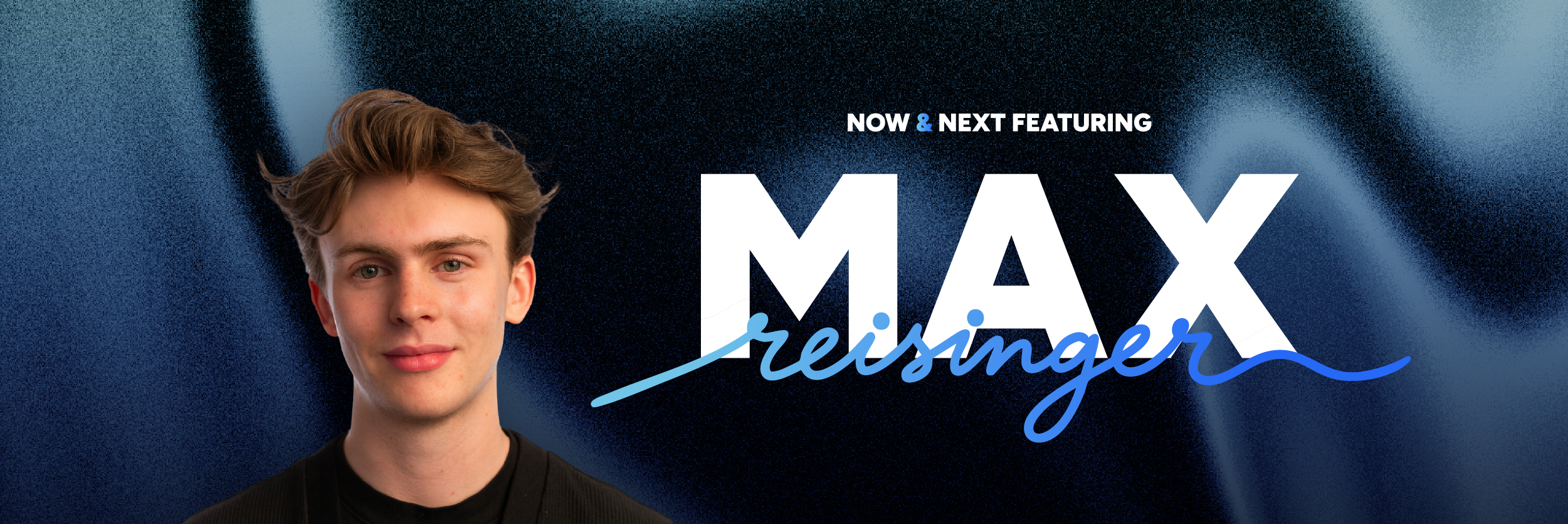
This feature is part of the Voices of the Now & Next series—a collaboration between VaynerSpeakers and the New York Stock Exchange, highlighting influential leaders shaping markets, culture, and business today.
Max Reisinger | CEO, Creator Camp

It might seem contradictory: a generation raised on phones, and a creator-turned-studio-head betting on movie theaters. For Reisinger, the two go hand in hand.
"The medium is the message," he says, borrowing from Marshall McLuhan. "Since the beginning of time, humans have gathered in dark spaces around light, from fires to movie theaters. That's intrinsic to the human experience."
Theaters demand intention. You put your phone away. You commit. And crucially, they carry trust. "On YouTube, anyone can post anything, so you don't necessarily trust what you're watching. That changes how you make the content, too."
It's also why Camp Studios started with theatrical releases rather than streaming. "It values the media so much higher, especially for us as a newer studio; it helps value it in the marketplace." On streaming fatigue, he's blunt: "I have decision fatigue. I sometimes don't even want to go on Netflix. I think the lost art is curation."
Reisinger famously shifted his framing from building a bridge to Hollywood to building an entirely new highway. What does that road look like for a young filmmaker starting today?
"You might not even need to go to Hollywood to get permission," he says. "With the movie we made, it was our money, we cultivated an audience online, we went directly to theaters, that audience showed up, and we had a profitable movie. That's an entirely new lane that did not exist before."
Interestingly, the journey has deepened his empathy for the old guard. "It's made me understand why Hollywood is the way it is, and why it's gatekept in many ways. But now people can earn it if they have an idea. There's just another path."
That philosophy extends to the Camp Film Festival, which he hopes can become a new stamp of quality. The fix, he's found, lies in the programming. "The issue with a lot of Hollywood right now is that it's detached from what audiences want, decided by people who aren't as connected to this generation. For us, it's about closing that gap and moving at the speed of culture."
He points to A24 as the model for what comes next: curation as brand. "People will watch it because it's an A24 movie. Building that curation and taste helps consumers, and it lets you push audiences toward things they didn't know they wanted. That's the job of the curator. But it's hard to do without trust."
Ask Reisinger about the legacy he wants Creator Camp to leave twenty years from now, and he'll point to one of the company's core mantras: make timeless work.
"I call it the poster-on-the-wall effect," he says. "Growing up, what movie poster did you have on your wall? Could it be our brand, or something we make? That's the effect we want to have on this next generation, to be deeply imprinted into people's lives and make them feel something timeless."
Growing up, Reisinger wanted to be an architect. In some ways, that's exactly what he became. "I like the blueprints," he says. "The infrastructure has become the art."